Roof leaks are rarely mysterious once you understand how water behaves on a roof. It enters at a defect, follows gravity and framing, and reveals itself somewhere else. Good leak repair traces that path back to the source and fixes it there.
Why is the leak never where the stain is?
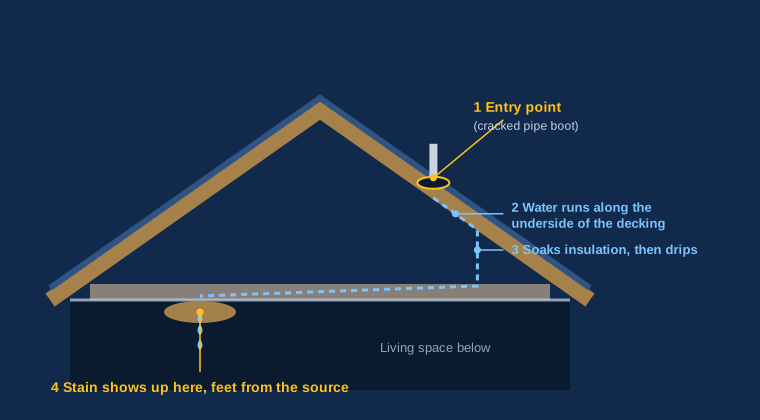
Water that gets through the roof covering lands on the underlayment and decking, then runs downhill along the underside of the decking. It follows rafters, collects at nails and joints, and soaks into insulation, where it can spread sideways before dripping onto a ceiling. The stain shows up where the water finally finds a path down, which may be many feet from the entry.
This is why patching over a stain, or sealing what looks like the nearest defect, so often fails. The stain is the end of the story, not the beginning.
How is a roof leak found?
Interview and interior check
When does it leak? Only in wind-driven rain, only after a long soak, only in winter? Those answers narrow the suspects. The ceiling, walls and any nearby fixtures are checked for the size and shape of the damage.
Attic inspection
With access, the underside of the roof deck is examined for dark stains, wet insulation, rusted nail tips and daylight. Following the water trail uphill shows where it entered.
Roof surface and details
Above the suspected area, the roof is examined: shingles, pipe boots, vents, flashing, valleys, skylights, chimney and wall joints. The entry is normally the highest defect that lines up with the wet area.
Water test if needed
If the defect is not obvious, water is applied to isolated areas of the roof, starting low and working upward, while someone watches inside. The area that produces the leak is the source.
What are the most common sources of roof leaks?
| Source | Why it leaks | Typical repair |
|---|---|---|
| Pipe boots (vent collars) | The rubber gasket cracks in the sun and lets water run down the pipe | Replace the boot, seal the flange correctly |
| Chimney and wall flashing | Metal loosens, rusts, or was sealed with caulk alone | Re-flash with step flashing and counterflashing |
| Cracked or missing shingles | Age, wind or impact break the surface | Replace shingles, seal, check the underlayment |
| Exposed or popped nails | Nail heads back out and pierce the shingle above | Reset or replace and seal |
| Valleys | Debris or wear lets water run beneath the shingles | Clean, repair or reline the valley |
| Skylights | Failed flashing or seals around the frame | Re-flash the curb, replace the seal |
| Roof vents | Cracked housing or lifted flange | Replace the vent, flash properly |
| Low-slope roof seams | Seams open, membrane blisters or punctures | Clean, prime, patch with reinforcement |
| Clogged gutters | Water backs up under the roof edge | Clear, repair and re-pitch gutters as needed |
What does leak repair involve?
Once the source is confirmed, the repair follows the cause. Pipe boots are replaced, not caulked. Damaged shingles are removed and replaced, and their neighbors are re-sealed. Flashing is rebuilt so the upper metal overlaps the lower, sending water down and out. Membrane roofs are cleaned, primed and patched with reinforcement.
If the decking is wet or soft, the affected boards or plywood are cut out and replaced. Roofing over damp wood locks in moisture and sets up the next failure, so this step is not optional.
Why do leaks come back after a repair?
Almost always for one of four reasons, and knowing them helps you judge any repair, ours or anyone else's.
- The wrong spot was repaired. The stain was chased, not the source.
- A sealant was used instead of a repair. Caulk over a cracked shingle or a failing flashing lasts a season or two at best.
- There is more than one entry point. A roof can have two leaks that reinforce each other, and only one gets fixed.
- The roof itself is failing. When the whole surface is worn out, new leaks open next to old ones.
What about the damage inside?
Deal with the roof first, then the interior. Wet insulation should be removed and replaced, because it doesn't dry well and it stops insulating. Drywall that is sagging, crumbling or moldy should be cut out. If the drywall is only lightly stained, dry and firm, let the area dry completely, then prime with a stain-blocking primer before painting.
If you see mold
Small patches on drywall surfaces can be cleaned by a homeowner with proper protection. Larger areas, or mold in insulation and framing, are best handled by a remediation professional. Fix the water source first, or the mold returns.
How can you prevent roof leaks?
- Have the roof inspected once a year, and after major storms.
- Keep gutters and valleys clear of debris so water drains rather than backs up.
- Trim limbs that overhang the roof.
- Replace pipe boots and re-check flashing when the roof is mid-life, not after it leaks.
- Repair damaged shingles promptly. The related pages on shingle repair and flashing repair have the details.
An annual roof inspection catches most of these before they turn into water in the house.
How much does roof leak repair cost?
Leak repair prices depend mostly on how hard the source is to find and how much wet material has to come out. These are estimated ranges, not quotes.
| Leak situation | Estimated range | What is involved |
|---|---|---|
| Pipe boot or vent leak | $200 to $550 | Replace the boot or vent, seal the flange |
| Cracked or missing shingles | $250 to $800 | Replace shingles, seal, check underlayment |
| Flashing leak | $300 to $800 | Reseal or rebuild a section (chimney rebuilds run higher) |
| Hard-to-find leak | $400 to $1,200 | Extra time tracing and testing before the repair |
| Leak with rotted decking | $1,200 to $4,000+ | Cut out and replace wet wood, then repair the roof covering |
How to read these numbers
These are ballpark estimates for planning, not quotes. They draw on published 2026 U.S. repair-cost ranges, and northern New Jersey labor rates often land toward the upper end. Your actual price depends on access, roof height and pitch, materials, how much wood is wet, and weather. It is confirmed in a written estimate after the inspection and before any work starts.
Interior repairs such as drywall, insulation and paint are separate from the roof repair, and they are the reason it pays to fix a leak early.
How do ice dams and freezing weather cause leaks?
In winter, heat escaping from the house can melt snow on the upper roof. The meltwater runs down to the cold overhang, refreezes, and builds a ridge of ice at the eave. Water behind that ridge backs up under the shingles and finds nails and joints that are normally above the waterline.
The result is a leak that shows up along exterior walls and near the eaves in cold weather, often with no obvious damage on the roof. The lasting solutions are air sealing and insulation in the attic, plus proper ventilation, and where the roof is being rebuilt, a waterproof membrane along the eaves. Repair on the roof surface alone will not solve an ice dam problem.
How does leak repair differ by roof type?
The principle is the same, but the method changes. On an asphalt shingle roof, the entry point is usually a cracked shingle, a lifted tab, or a detail like a pipe boot or flashing. On a flat roof, the membrane is one continuous surface, so leaks come from seams, punctures, blisters, the flashing where the membrane runs up a wall, or a drain that has stopped draining. Water on a flat roof also travels farther under the membrane than on a sloped roof, which makes the source harder to find.
Our flat roof repair page covers those repairs in detail.
Where do we handle leak repair?
Roof leak repair for homeowners in Kearny, NJ (07032 and 07099), including rowhouses, multi-family buildings and single-family homes across Hudson County. The service areas page has the details, including how we handle addresses in neighboring towns.
Frequently asked questions
Why does my roof only leak during heavy rain or wind?
Wind-driven rain pushes water sideways and upward, into gaps that stay dry in ordinary rain, such as a loose flashing joint or a lifted shingle edge. Heavy rain overwhelms marginal details. Both point to a specific weak spot, which is good news, since specific weak spots are repairable.
How do you find the source of a roof leak?
By working outward from the stain: checking the attic, following the water trail along the underside of the decking, then inspecting the roof above for the highest defect that lines up. On difficult leaks, a controlled water test with a hose can isolate the entry point, working from the lowest part of the roof upward.
Can a leak be fixed from the inside?
No. Interior work such as drywall and paint only hides the damage. The leak has to be stopped at the roof, and the interior repaired after everything has dried.
My roof is new but still leaks. Why?
New roofs usually leak at details rather than in the field: flashing installed without proper overlaps, nails driven through the wrong place, pipe boots not sealed, or a roof-to-wall joint that relies on caulk. These are fixable, and workmanship problems are worth documenting.
Is a small leak an emergency?
A slow drip is not an emergency, but it is not something to leave. Small leaks turn into wet insulation, rotted decking and mold. Get it inspected within days.
Will roof sealant fix my leak?
Sealant can close small gaps at details for a while, but it is not a repair for cracked shingles, failed flashing or torn membranes. Products applied over an unidentified leak often trap water and hide the real source.
How long does leak repair take?
Straightforward leaks such as a pipe boot or a few shingles are often repaired in one visit. Finding a hidden leak, rebuilding flashing, or replacing rotted decking takes longer. As a rough estimate, a leak with a clear source costs about $350 to $1,200, and a leak that has damaged decking runs about $1,200 to $4,000 or more.
Do I need to replace my ceiling after a leak?
Not always. If the drywall is dry, firm and not sagging, it can be primed and painted. Saturated, sagging or moldy drywall and insulation should be removed. That decision comes after the roof is fixed and the area has dried.