Shingles shed water across open roof planes. Flashing handles the hard part: the places where the roof meets something else, like a chimney, a wall, a valley or a pipe. Most leaks that recur after a repair are flashing leaks that were caulked instead of fixed.
What does roof flashing do?
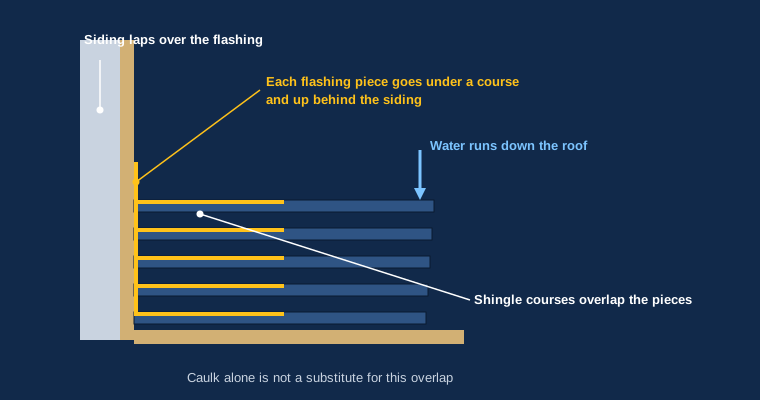
Water runs downhill and will find any joint it can. Flashing is layered metal that guides the water over and around the joint so that it never has a straight path in. The principle is shingle-style overlap: the upper piece always laps over the lower piece, so gravity carries water on top of every seam.
That principle is why sealant is only a backup. Sealant depends on adhesion and flexibility, and roofs move. Overlap depends on gravity, which doesn't wear out.
Where does flashing fail?
| Location | How it should work | How it fails |
|---|---|---|
| Chimney | Base flashing on the roof, counterflashing set into the masonry, a cricket behind wide chimneys | Counterflashing pulls out of mortar, sealant cracks, missing cricket lets water pool |
| Sidewall | Step flashing woven with shingles, siding overlapping the vertical leg | Caulk-only detail, flashing hidden behind siding that was never installed |
| Headwall | Apron flashing where the roof meets a wall at the top | Sealed at the top only, opens with movement |
| Valleys | Open metal valley or woven shingle valley with a waterproof membrane below | Rusted metal, debris buildup, nails through the valley |
| Skylights | Flashing kit sized for the unit, integrated with shingles | Bent or rusted kit, seal failure at the curb |
| Pipe and vent penetrations | Flanged boot lapped under upper shingles | Cracked rubber collar, exposed nail heads |
| Roof edges (drip edge) | Metal at eaves and rakes directs water into the gutter | Missing or short drip edge lets water get behind the fascia |
How is roof flashing repaired?
Inspect and trace
The flashing and adjacent shingles, siding or masonry are examined for gaps, rust, lifted edges and sealant failure. Interior staining is checked to confirm the flashing is the source.
Remove the failed section
Old sealant and damaged metal are removed. Shingles at the joint are lifted where necessary so the new flashing can be laid correctly under them.
Install new flashing with overlap
New metal is cut and shaped for the joint. Step flashing is woven course by course. Counterflashing is set into the masonry or behind the siding to lap over the base flashing.
Fasten and seal
Fasteners go where they won't be exposed to running water. Sealant is applied only at edges and terminations where it supplements the overlap.
Restore surrounding materials
Shingles are re-laid and re-sealed, siding is put back, and the joint is checked for a clean water path.
Why caulk alone keeps failing
Roof caulk is a flexible sealant that bonds to surfaces. Over time, sun, thermal movement and water break the bond. A roof leak sealed with caulk often reappears within a year or two, usually right at the line of the caulk. If your flashing has been caulked repeatedly, that is the signal to have the metal itself reworked.
What about chimney flashing?
A chimney is the hardest detail on a roof to keep dry. It has four sides that each need different flashing, and the uphill side collects water that has to be diverted. On wide chimneys, a small peaked cricket behind the chimney splits the water and sends it around both sides. Without it, debris and standing water build up and lead to leaks.
Counterflashing that is cut into the mortar joints (a reglet) and sealed is the standard. If the mortar is crumbling, the masonry may need repointing before the flashing can be secured. A chimney that leaks can be a roofing issue, a masonry issue, or both, and a good inspection separates the two.
How does flashing wear out?
Metal gets bent by ice and by thermal movement, corrodes where dissimilar metals touch, and works loose where nails back out. Sealants dry out, and wall movement pulls flashing away from siding or masonry. Trees and debris accumulate in valleys and behind chimneys, holding moisture against the metal.
Poor installation is also common. Flashing that was installed without overlap, sealed only with caulk, or cut too short to reach under the shingles will leak sooner or later, no matter how new it is.
How do you keep flashing in good condition?
- Look at flashing from the ground with binoculars after storms, checking for gaps, bent metal and cracked sealant.
- Keep valleys and areas behind chimneys clear of leaves and debris.
- Have flashing checked as part of a yearly roof inspection.
- Repair small gaps promptly before water finds a route inside.
If you already have a stain near a flashing joint, see roof leak repair for how the water is traced, and roof patch repair for the broader picture.
What is flashing made of, and does it matter?
Most residential flashing is aluminum or galvanized steel, with copper on higher-end or historic work and rubberized or membrane flashing at some low-slope details. Aluminum is light and easy to shape but reacts badly with concrete and mortar, so it needs a protective coating where it touches masonry. Galvanized steel is strong but rusts once the coating wears through. Copper lasts a long time but should not be mixed with other metals on the same roof, because contact between different metals speeds up corrosion.
The right material is the one that is compatible with the roof, the wall and the neighboring metals. A repair that mixes metals or uses the wrong sealant can fail faster than the original.
What are the signs flashing was installed wrong?
- Thick beads of sealant doing the work where metal should overlap.
- One long strip of metal along a wall instead of separate stepped pieces.
- Flashing nailed through the exposed face, with nail heads in the water path.
- Metal that ends short of the wall or that sits on top of the shingles instead of under them.
- No counterflashing at a chimney, only a line of caulk.
Flashing that was done this way often leaks within a few years, sometimes right after a new roof. A good inspection can identify these details and explain them.
How much does flashing repair cost in Kearny?
The amount of flashing, the height and steepness of the roof, and the condition of what surrounds it are the main factors. These are estimated ranges, not quotes.
| Flashing job | Estimated range | Notes |
|---|---|---|
| Reseal or repair a short section | $200 to $500 | Minor gaps and lifted metal |
| Sidewall step flashing | $300 to $900 | Depends on the length of the wall |
| Skylight re-flash | $400 to $1,200 | Kit and shingle work around the curb |
| Valley repair | $500 to $1,800 | Metal valleys and woven valleys differ |
| Chimney flashing rebuild | $600 to $2,000 | Counterflashing and cricket; masonry work extra |
How to read these numbers
These are ballpark estimates for planning, not quotes. They draw on published 2026 U.S. repair-cost ranges, and northern New Jersey labor rates often land toward the upper end. Your actual price depends on access, roof height and pitch, materials, how much wood is wet, and weather. It is confirmed in a written estimate after the inspection and before any work starts.
Masonry repair, rotted sheathing under the flashing, and siding that must be removed and replaced add to the scope. You get a written estimate after inspection and before work begins.
Where do we do flashing repair?
We repair roof flashing on Kearny, NJ homes (ZIP codes 07032 and 07099), including the attached and multi-family houses where sidewall and party-wall flashing are especially common. See the service areas page for coverage details.
Frequently asked questions
What is roof flashing?
Flashing is thin metal, usually aluminum, galvanized steel or copper, installed at joints and penetrations to direct water away from places where roofing materials meet other surfaces. It is used at chimneys, walls, valleys, skylights, dormers, vents and roof edges.
Can I just caulk my flashing?
Caulk can slow a small leak for a while, but it is not a repair. Sealants dry out, crack and pull away with the movement of the roof. Properly overlapped metal flashing is the durable solution, with sealant as a backup at specific spots.
How do I know if flashing is leaking?
Common signs are stains on the ceiling or wall next to a chimney or wall junction, water that appears mainly during wind-driven rain, visible gaps or rust at the metal, and sealant that is cracked or missing.
How long does roof flashing last?
Metal flashing can last a long time, but the sealants and fasteners that hold it wear out sooner. It is worth having flashing checked once a year and re-sealed or replaced when there are signs of wear.
What is step flashing?
Step flashing is a series of small L-shaped metal pieces installed where a sloped roof meets a vertical wall. Each piece overlaps the one below and sits under a course of shingles, so water is carried down and out. It is the standard sidewall detail.
Why does my chimney leak?
The chimney is one of the most complex flashing details on any roof. Leaks come from failed flashing, deteriorated mortar or crown, a missing cricket (a small diverter) behind a wide chimney, or counterflashing that has separated from the masonry.
Do I need a mason as well as a roofer for a chimney leak?
Sometimes. The flashing is roofing work, but the mortar joints, masonry and crown belong to a mason. An inspection helps determine which part is failing.
How long does flashing repair take?
Small repairs such as resealing or replacing a section can be done in a visit. Rebuilding chimney or long wall flashing takes longer, especially on high or steep roofs. As a rough estimate, small flashing repairs run about $200 to $800 and chimney rebuilds about $600 to $2,000.